Retail customers pay brands or shops; brands pay through the chain.
Route status · Lucknow · route completeYou’re reading · Ada Chikan + SEWA Lucknow
ORGANISATION FIELD BRIEF
FIELD EDITIONAda Chikan + SEWA Lucknow
Hand embroidery, home-based work and collective organisation
Chikankari garments are embroidered by women working at home and paid by the piece through intermediaries, while SEWA organises workers to change the terms on which that happens.
WHY THIS VISIT IS USEFUL
It shows how distributed quality, piece-rate work and collective bargaining change who carries rejection risk.
WHAT IT CANNOT ESTABLISH
A centre visit cannot establish income stability or conditions across thousands of home-based workers.THE SYSTEM MODEL
Who acts, who pays and who carries the downside?
Wearers and home-based embroiderers.
Designers, agents, inspectors, brands and—in organised settings—collective bargaining.
An individual artisan often bears unpaid rejection after investing the hours.
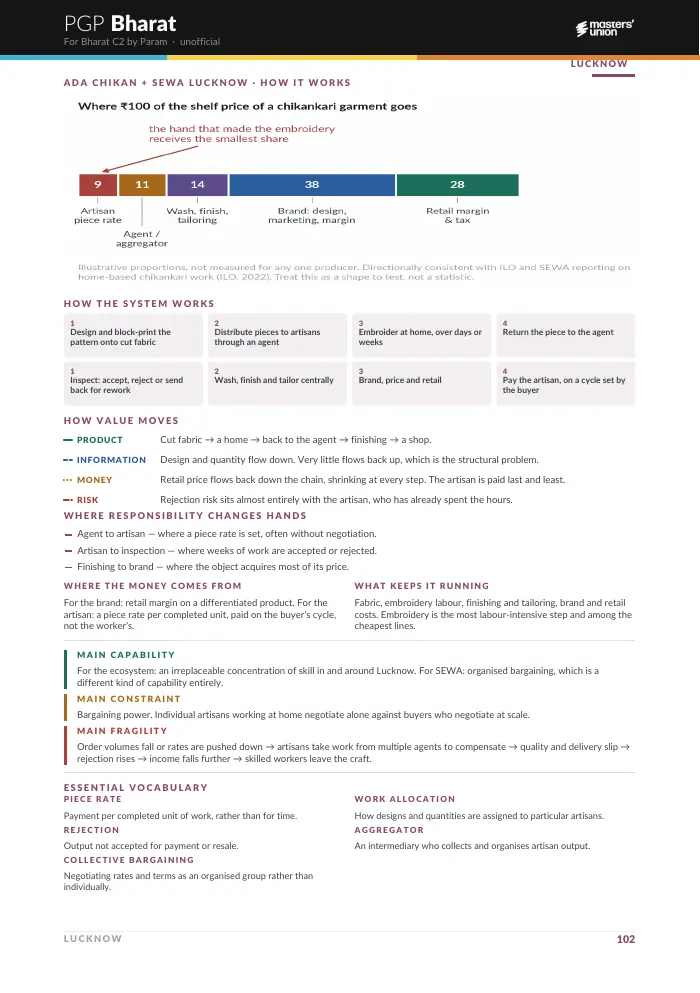
Cut fabric → home → agent → finishing → shop.
Design and quantity move down; little bargaining information moves back up.
Retail price shrinks down the chain; the artisan is paid last and least.
Rejection sits with the artisan after the labour has already been performed.
Irreplaceable craft skill; SEWA adds organised bargaining and grievance mechanisms.
Bargaining power of isolated home workers against scaled buyers.
Rates or orders fall → artisans take more agents’ work → quality and delivery slip → rejection rises → income falls → skilled workers exit.
ON THE GROUND
Look for evidence—not presentation polish.
What to notice
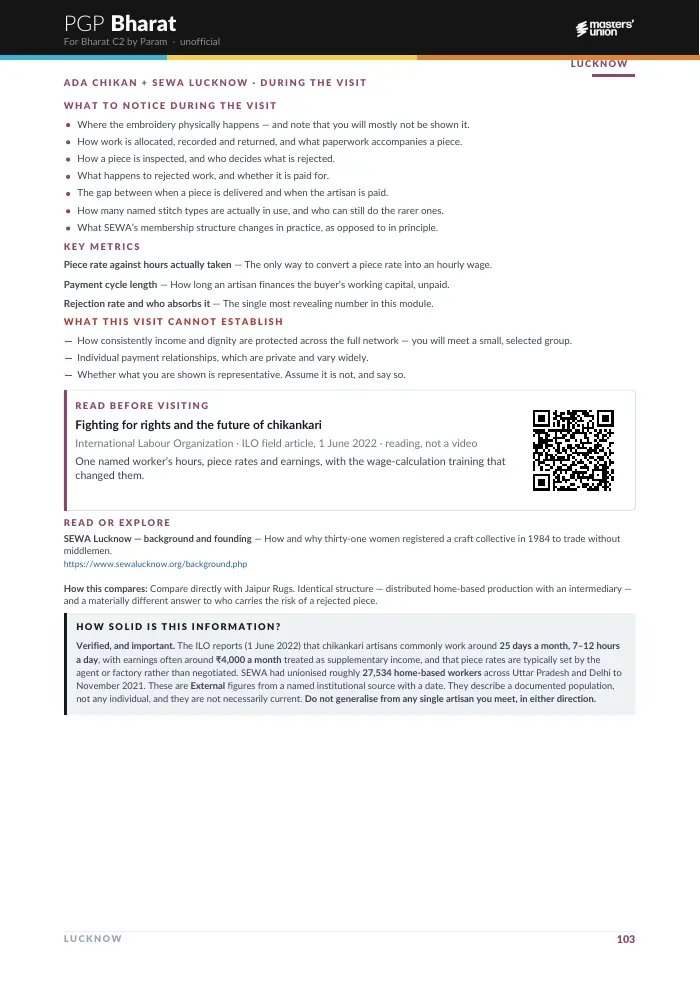
- Where embroidery quality is checked
- How work and designs are allocated
- Who pays when a piece is rejected
Numbers that reveal the system
- Piece rate by stitch and complexity
- Rejection and rework rate
- Payment delay
Critical handoffs
- Agent to artisan
- Artisan to inspection
- Finishing to brand
THE C1 REALITY LAYER
Advice at the moment you need it.
Past-cohort precedent is separated from current C2 instructions. Anything changeable remains marked C2 VERIFY.Prepare the conditions
Research the structure before meeting the craft
C1 preparation covered chikankari economics, artisan roles, movement from unstructured clusters to organised retail, and the tension between art and commercialisation.
C1 Ada/SEWA preparation archiveTrace the operating system
Follow one garment through both realities
C1 deliberately contrasted the polished retail-facing system with worker livelihoods. Trace design allocation, home embroidery, inspection, rejection, payment delay and customer ownership.
- Ask who allocates designs.
- Find who pays for rejected work.
- Ask how long payment takes.
- Test whether an artisan can refuse a low piece rate.
Turn experience into evidence
Test provenance against bargaining power
After the visit, compare the brand’s origin story with the worker’s actual ability to negotiate allocation, quality decisions, piece rates and payment timing.
C1 Ada/SEWA synthesisDEEPER EXPLANATION
What collective organisation changes
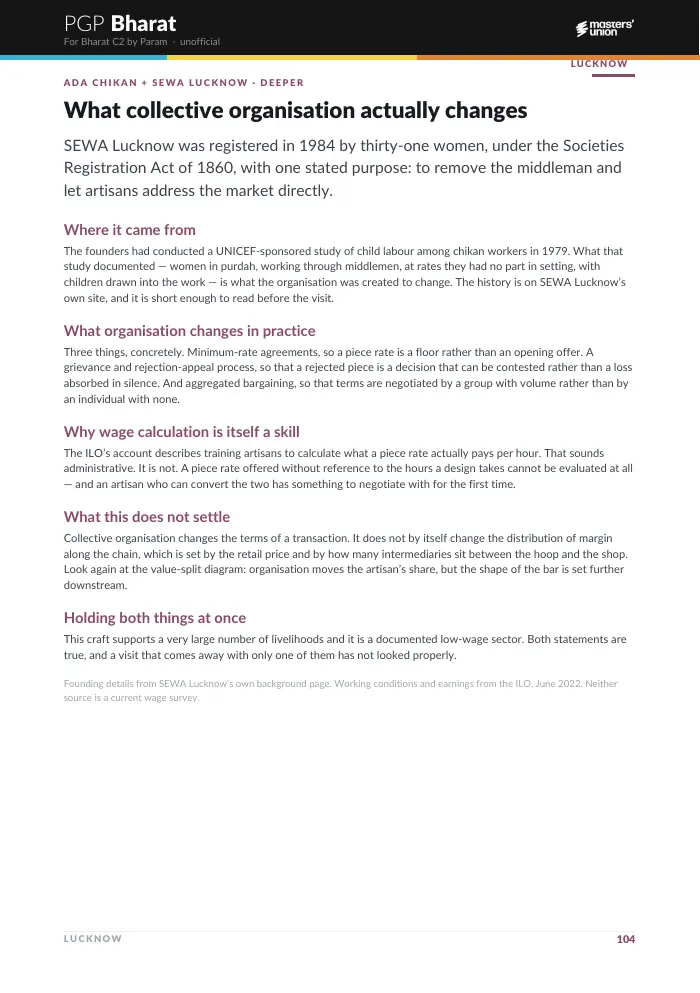
SEWA Lucknow was registered in 1984 by thirty-one women to remove the middleman and address the market directly.
Organisation can create minimum-rate agreements, a rejection-appeal process and bargaining at group volume.
Converting a piece rate into an hourly rate is itself power: without knowing the hours, a worker cannot evaluate the offer.
Collective organisation can improve terms, but does not alone determine how the retail margin is distributed across the chain.
Founding details come from SEWA Lucknow; documented worker conditions in the guide come from a dated ILO account, not a current wage survey.USEFUL WORDS
Speak the language without hiding behind it.
- Piece rate
- Payment per completed unit.
- Work allocation
- How designs and quantities are assigned.
- Rejection
- Output not accepted for payment or resale.
- Aggregator
- Intermediary organising distributed output.
- Collective bargaining
- Negotiating as a group rather than alone.
Evidence boundary
Do not generalise from one selected artisan. The guide distinguishes dated external evidence from conditions observed on the day.
Compare with Jaipur Rugs: similar production structure, different governance and bargaining power.
WATCH / READ / EXPLORE
THE EXACT DESIGNED PAGES