Households, builders, contractors and institutional buyers.
Live route status · Lucknow · current hubYou’re reading · Havells India
ORGANISATION FIELD BRIEF
FIELD EDITIONHavells India
Branded consumer electricals and durable goods
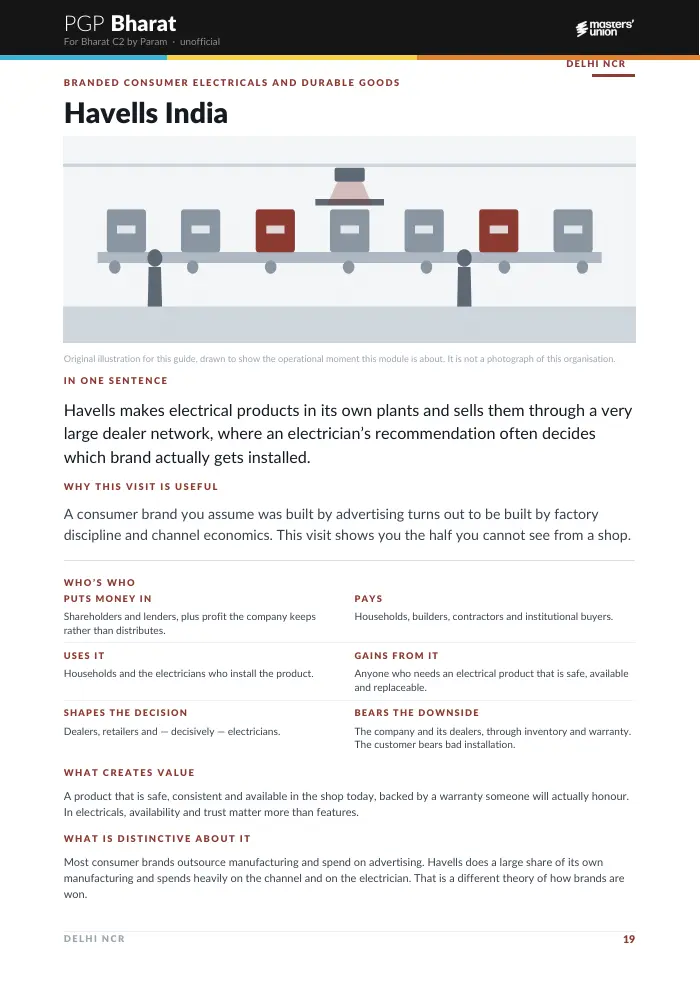
Havells makes electrical products in its own plants and sells them through a very large dealer network, where an electrician’s recommendation often decides which brand gets installed.
WHY THIS VISIT IS USEFUL
A consumer brand that looks advertising-led is also a factory-discipline and channel-economics business.
WHAT IT CANNOT ESTABLISH
One plant cannot establish portfolio-wide demand, dealer incentives or end-to-end warranty performance.THE SYSTEM MODEL
Who acts, who pays and who carries the downside?
Households and the electricians who install the product.
Dealers, retailers and—decisively—electricians.
The company and dealers carry inventory and warranty risk; the customer carries bad-installation risk.
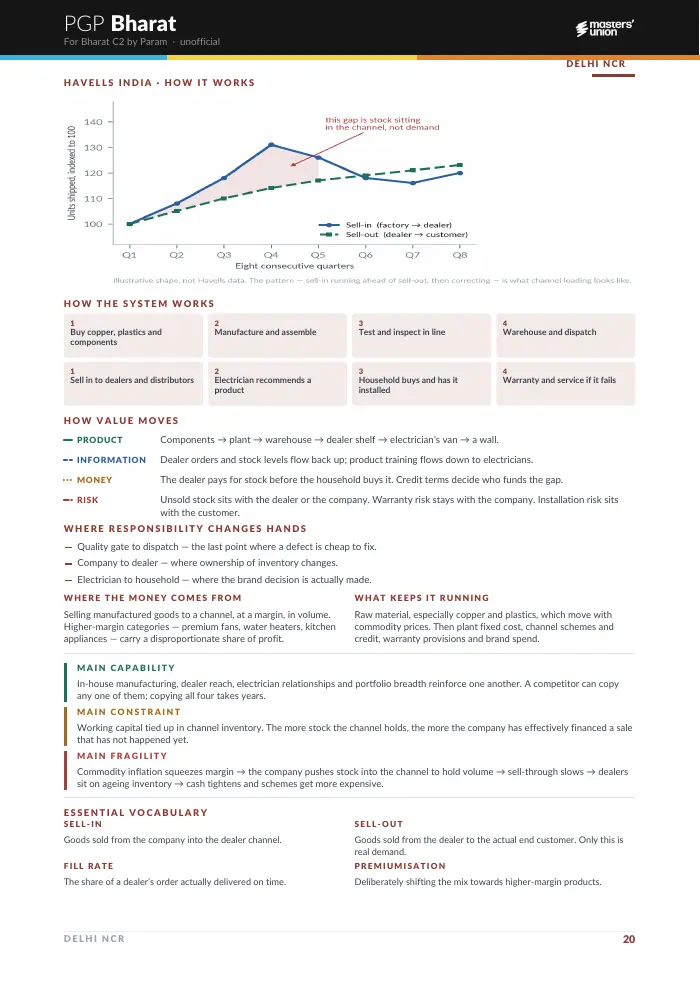
Components → plant → warehouse → dealer shelf → electrician’s van → a wall.
Dealer orders and stock levels flow back up; product training flows down to electricians.
The dealer pays for stock before the household buys it. Credit terms decide who funds the gap.
Unsold stock sits with the dealer or company. Warranty stays with Havells; installation risk sits with the customer.
In-house manufacturing, dealer reach, electrician relationships and portfolio breadth reinforce one another.
Working capital tied up in channel inventory. More stock can mean the company has financed a sale that has not happened.
Commodity inflation squeezes margin → stock is pushed into the channel → sell-through slows → inventory ages → cash tightens → schemes become more expensive.
ON THE GROUND
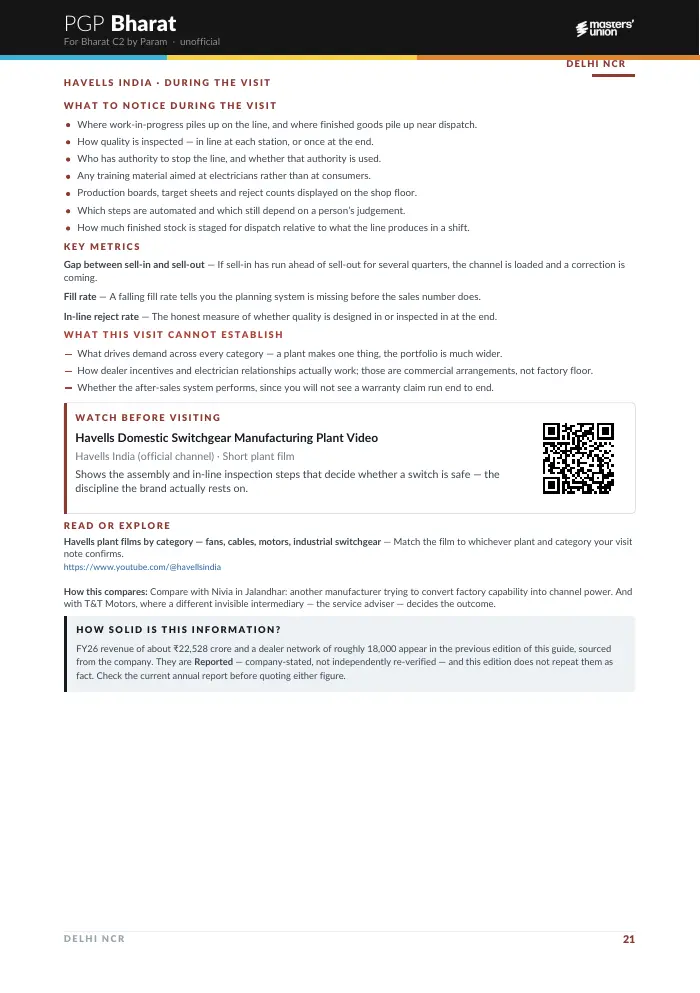
Look for evidence—not presentation polish.
What to notice
- Where work-in-progress and finished goods accumulate
- Whether quality is checked in-line or only at the end
- Material and training aimed at electricians rather than consumers
Numbers that reveal the system
- Gap between sell-in and sell-out
- Fill rate
- In-line reject rate
Critical handoffs
- Quality gate to dispatch—the last point where a defect is cheap to fix.
- Company to dealer—where ownership of inventory changes.
- Electrician to household—where the brand decision is actually made.
THE C1 REALITY LAYER
Advice at the moment you need it.
Past-cohort precedent is separated from current C2 instructions. Anything changeable remains marked C2 VERIFY.Connect it across the route
Havells has no direct C1 precedent
C1 visited adjacent manufacturing systems rather than Havells. Use those visits only to compare in-line quality, inventory build-up, factory-to-channel handoffs and the gap between a factory tour and proof of market demand.
C1 archive synthesis · adjacent manufacturing casesUSEFUL WORDS
Speak the language without hiding behind it.
- Sell-in
- Goods sold from the company into the dealer channel.
- Sell-out
- Goods sold from the dealer to the end customer. Only this is real demand.
- Fill rate
- The share of a dealer’s order delivered on time.
Evidence boundary
Company-scale figures in the guide are company-reported and should be checked against the current annual report before quotation.
Compare with Nivia: another manufacturer converting factory capability into channel power.
WATCH / READ / EXPLORE
THE EXACT DESIGNED PAGES