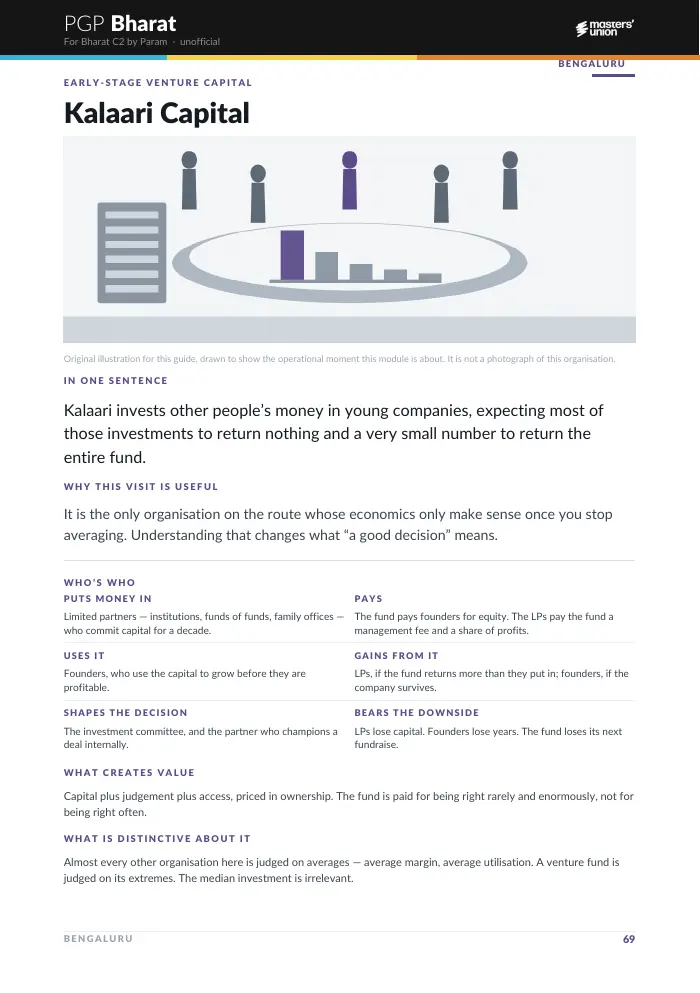
Limited partners commit capital and pay fees.
Live route status · Lucknow · current hubYou’re reading · Kalaari Capital
ORGANISATION FIELD BRIEF
FIELD EDITIONKalaari Capital
Early-stage venture capital
Kalaari invests other people’s money in young companies, expecting most to lose money and a very small number to return the entire fund.
WHY THIS VISIT IS USEFUL
Averages mislead in a power-law portfolio; ownership, reserves and access to exceptional founders drive the outcome.
WHAT IT CANNOT ESTABLISH
A discussion cannot reveal the counterfactual returns of missed deals or the private performance of the full portfolio.THE SYSTEM MODEL
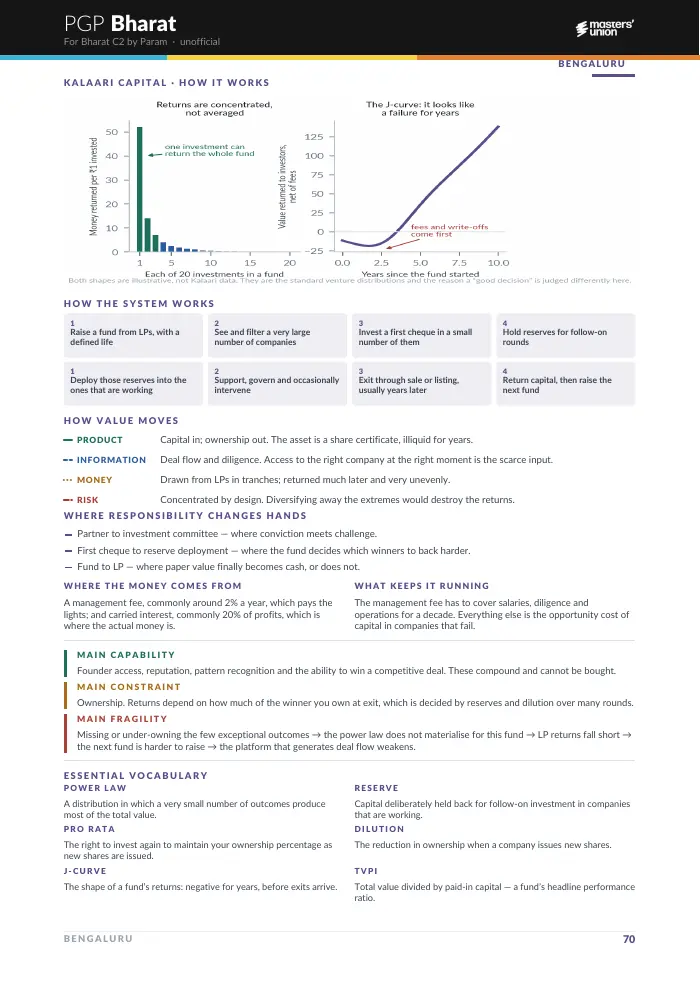
Who acts, who pays and who carries the downside?
Founders use the capital; LPs and founders gain if companies survive and exit.
Investment committee and the partner championing a deal.
LPs lose capital, founders lose years and the fund may lose its next fundraise.
Capital in; illiquid ownership out.
Deal flow and diligence—access at the right moment is scarce.
Drawn from LPs in tranches and returned much later, very unevenly.
Concentrated by design; removing extremes can remove the return.
Founder access, reputation, pattern recognition and the ability to win a competitive deal.
Ownership at exit, shaped by reserve decisions and dilution.
Miss or under-own the rare outlier → fund return falls short → next fund is harder → platform and deal flow weaken.
ON THE GROUND
Look for evidence—not presentation polish.
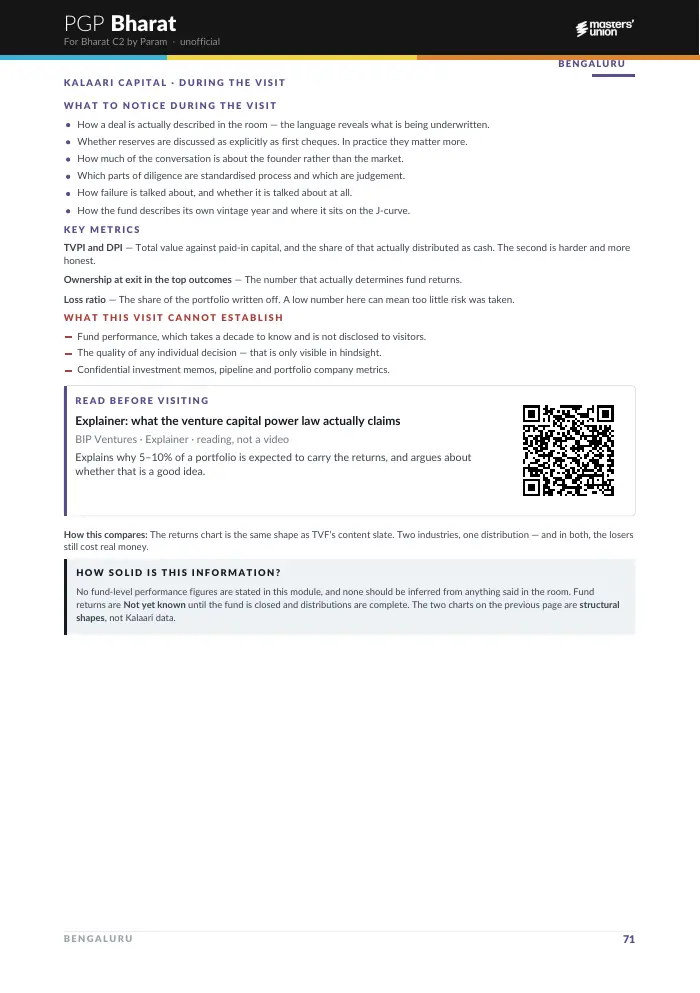
What to notice
- How a deal reaches the investment team
- Which evidence changes conviction
- How reserves are allocated after the initial cheque
Numbers that reveal the system
- TVPI
- Ownership at exit
- Reserve concentration
Critical handoffs
- Partner to investment committee
- First cheque to reserve deployment
- Paper value to cash returned to LP
THE C1 REALITY LAYER
Advice at the moment you need it.
Past-cohort precedent is separated from current C2 instructions. Anything changeable remains marked C2 VERIFY.Connect it across the route
Headline metrics can conceal a biased starting line
Use C1’s creator-metric debate as an adjacent case for venture power laws: followers and prior distribution can concentrate visible outcomes before quality is judged.
C1 Creator Challenge archive · adjacent caseDEEPER EXPLANATION
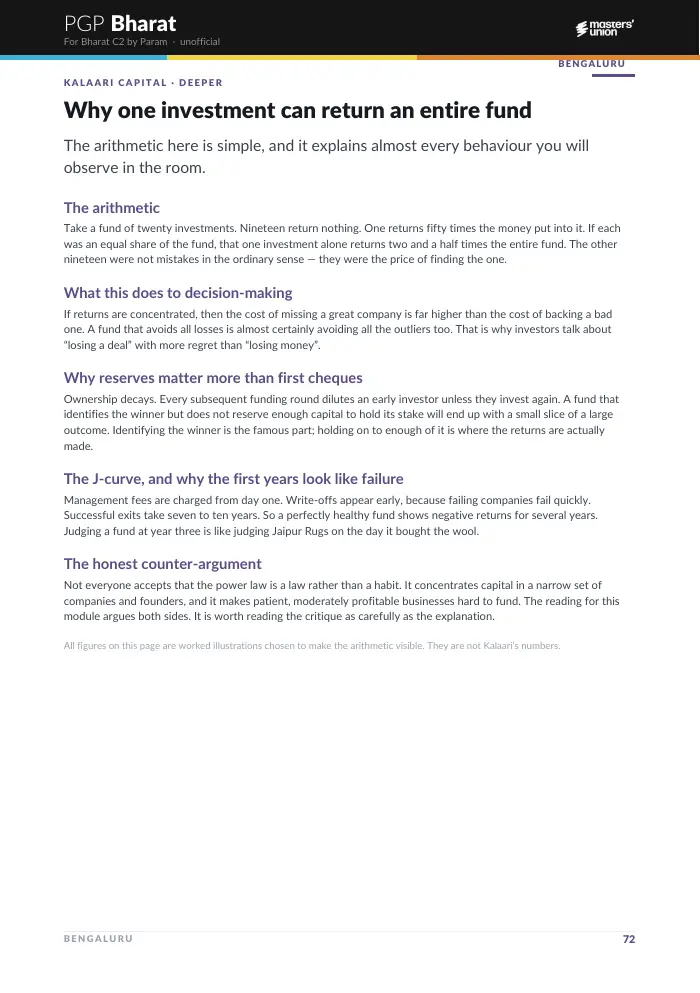
Why one investment can return an entire fund
If nineteen equal investments return nothing and one returns fifty times, that one can return two and a half times the whole fund. The losses were the price of finding the outlier.
The cost of missing an exceptional company can exceed the cost of backing a bad one. That changes what a prudent decision looks like.
Ownership decays through dilution. Finding a winner matters; reserving enough capital to hold a meaningful share is where returns are made.
Fees and write-offs arrive early while exits take years, producing the J-curve. Early negative marks can coexist with a healthy fund.
Worked illustration—not Kalaari data.USEFUL WORDS
Speak the language without hiding behind it.
- Power law
- A few outcomes produce most total value.
- Reserve
- Capital held for follow-on rounds.
- Pro rata
- Right to invest again to maintain ownership.
- Dilution
- Ownership reduction when new shares are issued.
- TVPI
- Total value divided by capital paid in.
Evidence boundary
Fund returns are Not yet known until exits and distributions are complete. Structural power-law charts are not portfolio data.
Compare with TVF: one hit can carry a fund or a slate.
WATCH / READ / EXPLORE
THE EXACT DESIGNED PAGES