Distributors, retailers, offices, schools and households.
Live route status · Lucknow · current hubYou’re reading · Kangaro Industries
ORGANISATION FIELD BRIEF
FIELD EDITIONKangaro Industries
Precision stationery and office products, press-tool manufacturing
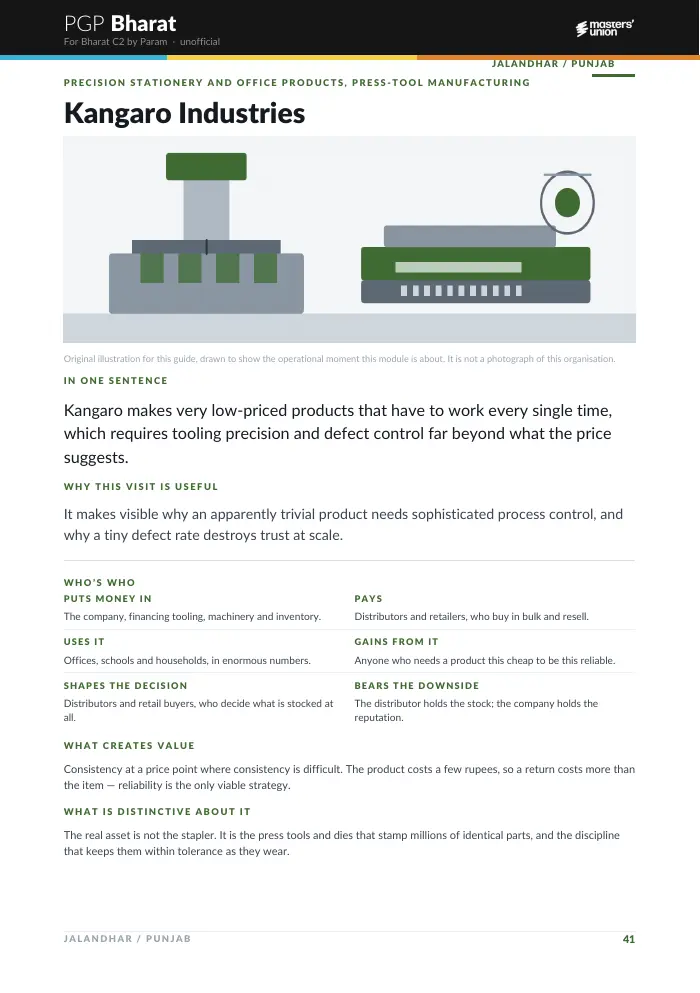
Kangaro makes very low-priced products that have to work every time, which requires tooling precision and defect control far beyond what the price suggests.
WHY THIS VISIT IS USEFUL
It makes tolerances, tool wear and repeatability visible in an everyday product.
WHAT IT CANNOT ESTABLISH
The factory cannot show distributor confidence, channel inventory or whether the brand earns pricing power.THE SYSTEM MODEL
Who acts, who pays and who carries the downside?
People who need a cheap mechanism to work every time.
Tool designers, production engineers, distributors and retailers.
The manufacturer bears scrap and warranty; the buyer bears failure at the point of use.
Metal and polymer → tool → components → assembly → pack → distributor → desk.
Specifications and tolerances move to tools; reject data must move back to maintenance.
Tiny contribution per unit only works at volume and high first-pass yield.
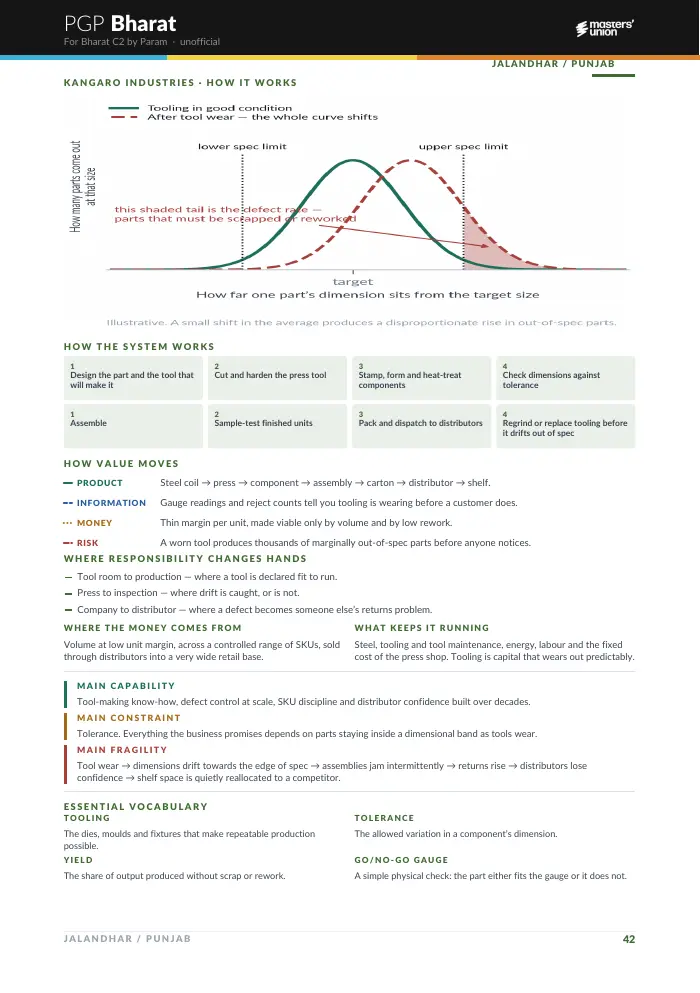
Tool wear creates thousands of defects before it becomes obvious.
Precision toolmaking, process repeatability and distribution built over decades.
Maintaining tolerances at a selling price that leaves almost no room for rework.
Tool wears → dimensions drift → defects repeat at volume → rework and returns erase the small unit margin.
ON THE GROUND
Look for evidence—not presentation polish.
What to notice
- Where dimensions are checked
- Signs of tool wear or rework
- How many variants share tools and components
Numbers that reveal the system
- First-pass yield
- Tool life
- Reject and rework rate
Critical handoffs
- Design to toolroom
- Tool to production line
- Inspection to packing
- Manufacturer to distributor
THE C1 REALITY LAYER
Advice at the moment you need it.
Past-cohort precedent is separated from current C2 instructions. Anything changeable remains marked C2 VERIFY.Connect it across the route
Use adjacent factories carefully
There is no direct C1 Kangaro precedent. Compare it with Nivia and other named C1 manufacturing cases through testing, tooling, defect detection and rework—never by relabelling an unrelated factory photo.
C1 archive synthesis · adjacent manufacturing casesUSEFUL WORDS
Speak the language without hiding behind it.
- Tolerance
- Permitted variation from a specified dimension.
- First-pass yield
- Share of output accepted without rework.
- Tool life
- Useful output before a die or mould needs repair.
- Repeatability
- Ability to produce the same result cycle after cycle.
Evidence boundary
A plant shows process capability, not distributor confidence, channel inventory or pricing power.
Compare with Havells and Nivia: factory capability is necessary but not sufficient.
WATCH / READ / EXPLORE
THE EXACT DESIGNED PAGES