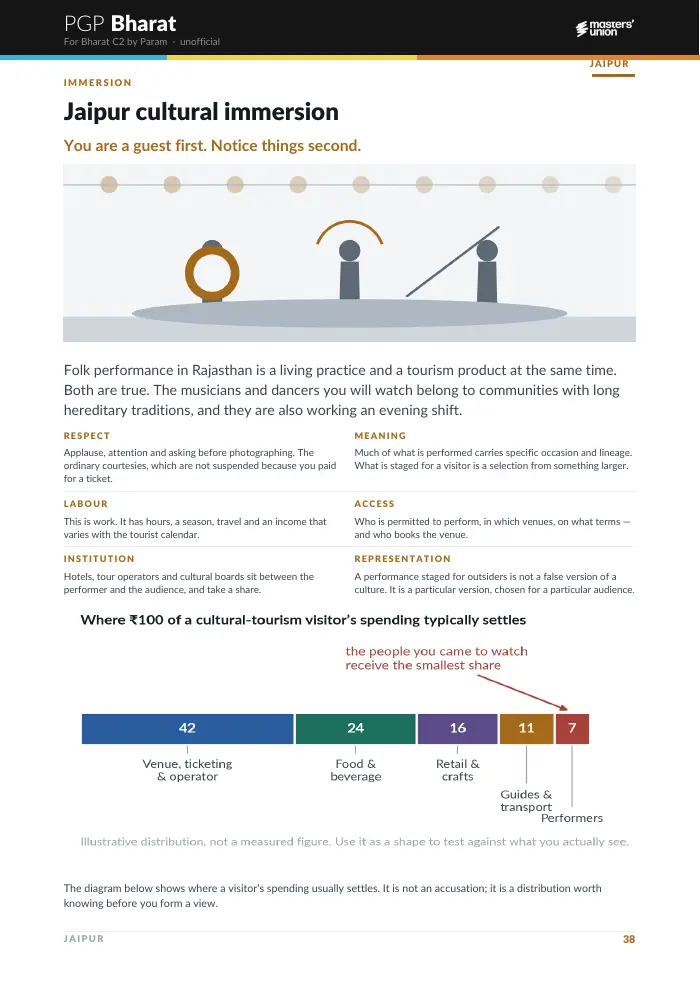
Visitors pay for tickets, food, travel and shopping. The money is shared across the organiser, venue and local providers.
Live route status · Lucknow · current hubYou’re reading · Jaipur cultural immersion
IMMERSION FIELD BRIEF
FIELD EDITIONJaipur cultural immersion
How a cultural experience is organised
A cultural programme brings performers, venues, food, travel and timing together to create one smooth experience for visitors.
WHY THIS VISIT IS USEFUL
Use this visit to see the people and work behind the experience.
WHAT IT CANNOT ESTABLISH
One performance cannot show how the whole cultural sector works or what every tradition means.THE SYSTEM MODEL
Who acts, who pays and who carries the downside?
Visitors, performers, guides, drivers, food sellers and craftspeople all take part.
The organiser and venue decide what visitors see, who can take part and when each activity happens.
Performers and small providers may lose the most when an event is cancelled, demand is weak or payment is late.
A living cultural practice is presented as a planned experience for visitors.
Hosts and performers explain what visitors are seeing and what it means.
Visitor spending is shared across the organiser, food sellers, shops, guides, drivers and performers.
Small providers may lose income when events are cancelled, few visitors arrive or payments are late.
Presenting culture with respect while still making it easy for visitors to understand.
Visitors have limited time and background knowledge. One evening cannot represent a whole culture.
The event is made faster and smoother → important context is removed → culture is shown as a stereotype → the people represented may receive the smallest share of the money.
ON THE GROUND
Look for evidence—not presentation polish.
What to notice
- Who starts and ends each part
- Which activities rely on tourists
- How visitor spending is shared
Numbers that reveal the system
- Share of visitors who buy
- Performer share of spending
- Events starting on time
Critical handoffs
- Local tradition to the planned programme
- Host to performer
- Performance to food and shopping
- Organiser to final payment
THE C1 REALITY LAYER
Advice at the moment you need it.
Past-cohort precedent is separated from current C2 instructions. Anything changeable remains marked C2 VERIFY.Trace the operating system
Follow one cultural business, not the whole city
For field content, select one vendor, performer or business worth following. Capture who attracts the customer, who performs the work, who gets paid and who owns the audience.
C1 Creator Challenge lessonsDEEPER EXPLANATION
You are a guest first. Notice things second.
Treat folk performance as a living tradition before you study it as a tourism experience. Respect the people, customs and place. Being an observer does not give you the right to interrupt or record everything.
Ask six simple questions: What does respect require? What does the performance mean? Whose work is hidden? Who gets to take part? Who organises the event? Who decides how the culture is shown?
Then follow the money. A smooth event can still divide earnings very unevenly among the people who created it.
The spending chart below is only an example. It is not actual programme data.USEFUL WORDS
Speak the language without hiding behind it.
- Representation
- Who gets to explain a culture or practice, and how they choose to show it.
- Access
- Who is allowed to join, perform or benefit.
- Example split
- A simple example used to ask questions. It is not actual programme data.
Evidence boundary
Use the spending chart only to ask how money may be shared. It does not show actual earnings for this programme or any performer.
Compare this with Goa hospitality and the Lucknow food walk. All three depend on many people working together.
THE EXACT DESIGNED PAGES