Tasting visitors, tea buyers and repeat customers.
Live route status · Lucknow · current hubYou’re reading · Mayukh / Darjeeling Tea Experience

ORGANISATION FIELD BRIEF
FIELD EDITIONMayukh / Darjeeling Tea Experience
Speciality tea retail, tasting and origin education
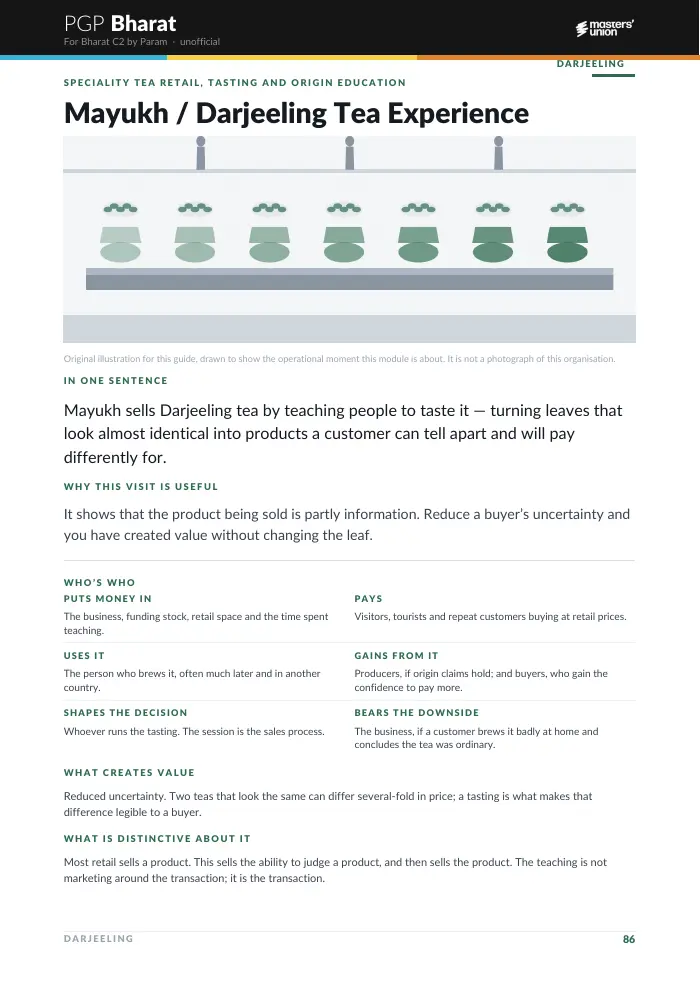
Mayukh sells Darjeeling tea by teaching people to taste it, turning leaves that look almost identical into products a customer can tell apart and pay more for.
WHY THIS VISIT IS USEFUL
The experience converts provenance and buyer education into willingness to pay.
WHAT IT CANNOT ESTABLISH
A tasting cannot establish estate practice, authenticity across the supply chain or customer behaviour after the visit.THE SYSTEM MODEL
Who acts, who pays and who carries the downside?
Tea drinkers and producers whose origin can command a premium.
The taster, seller, documentation and the buyer’s educated palate.
The seller carries lot and authenticity risk; producers bear weak-price risk.
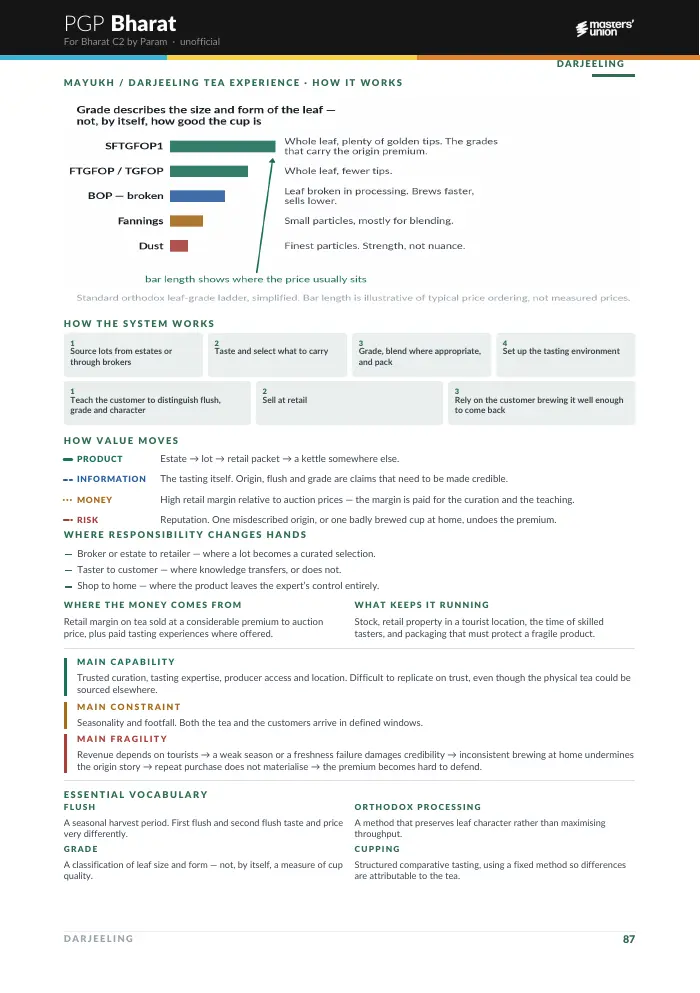
Estate lot → tasting table → selected pack → buyer.
Origin records and sensory language turn invisible variation into a comparable claim.
A credible distinction can move a leaf from commodity price toward speciality margin.
Weak documentation or inconsistent lots can make provenance feel like storytelling alone.
Sensory judgement and the ability to teach a buyer to perceive a difference.
Making variation legible without overstating what origin guarantees.
Provenance claim weakens → trust falls → buyer cannot justify premium → the lot returns toward commodity pricing.
ON THE GROUND
Look for evidence—not presentation polish.
What to notice
- How tasting is structured
- Which origin claims are documented
- How the seller handles variation between lots
Numbers that reveal the system
- Average realised price by lot
- Tasting-to-purchase conversion
- Repeat purchase
Critical handoffs
- Producer to curator
- Sample to interpretation
- Tasting to purchase
THE C1 REALITY LAYER
Advice at the moment you need it.
Past-cohort precedent is separated from current C2 instructions. Anything changeable remains marked C2 VERIFY.Prepare the conditions
Move from garden and market into price discovery
C1’s tea appreciation preceded the auction simulation. Use Mayukh to ask what turns geographic origin into defensible commercial provenance before you see how buyers price it.
C1 Darjeeling learning sequenceC1 PHOTO DISPATCH
Real archive · contextual, not illustrative stock
USEFUL WORDS
Speak the language without hiding behind it.
- Lot
- A traceable quantity offered as one unit.
- Flush
- A seasonal period of tea growth and plucking.
- Cupping
- Structured tasting used to evaluate tea.
- Realised price
- Price actually achieved, not listed or hoped for.
Evidence boundary
A tasting establishes a guided sensory comparison, not estate practice or chain-wide authenticity.
Compare with the Tea Auction: persuasion to one buyer versus discovery among many buyers.
WATCH / READ / EXPLORE
THE EXACT DESIGNED PAGES