Registered buyers bid and pay; producers supply lots and pay service costs.
Live route status · Lucknow · current hubYou’re reading · Tea Auction Ecosystem

ORGANISATION FIELD BRIEF
FIELD EDITIONTea Auction Ecosystem
Commodity price discovery, broking and settlement
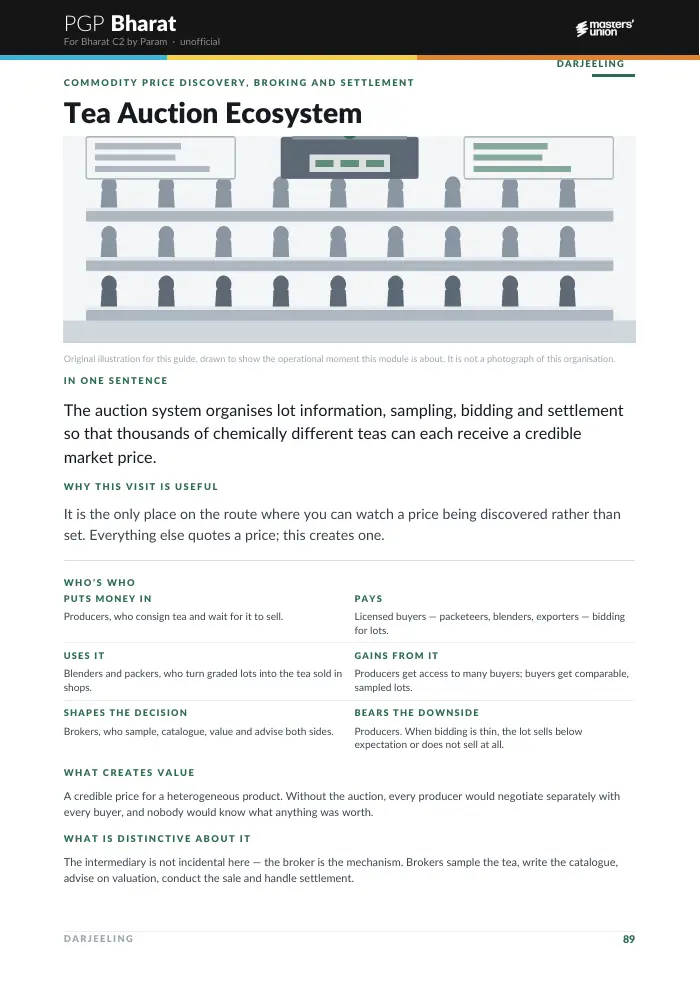
The auction system organises lot information, sampling, bidding and settlement so thousands of chemically different teas can each receive a credible market price.
WHY THIS VISIT IS USEFUL
It separates an asserted price from a discovered one and shows why bidder depth matters.
WHAT IT CANNOT ESTABLISH
Watching an auction cannot establish cup quality, producer cost or whether the discovered price is economically sustainable.THE SYSTEM MODEL
Who acts, who pays and who carries the downside?
Packers, traders and ultimately tea drinkers.
Brokers, tasters, bidder depth, reserve price and lot information.
Producers bear a weak price; buyers bear quality and resale risk; the system bears thin-bidding risk.
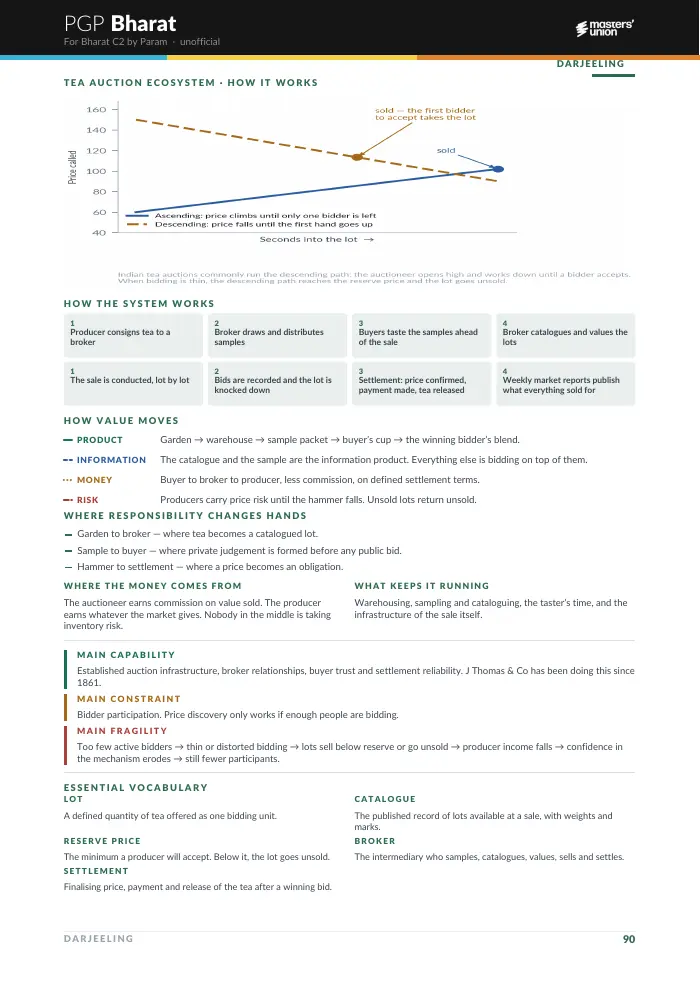
Tea lot → sample → warehouse → winning buyer.
Catalogue and cup report move before the physical lot; bids reveal willingness to pay.
Winning price settles through defined rules and charges.
Thin bidding can produce a formally valid price that is not deeply competitive.
Standardised lot identity, trusted sampling, many informed bidders and enforceable settlement.
Bidder depth for a specific lot at a specific moment.
Fewer active bidders → weaker competition → prices lose credibility → good sellers route volume elsewhere → auction depth weakens further.
ON THE GROUND
Look for evidence—not presentation polish.
What to notice
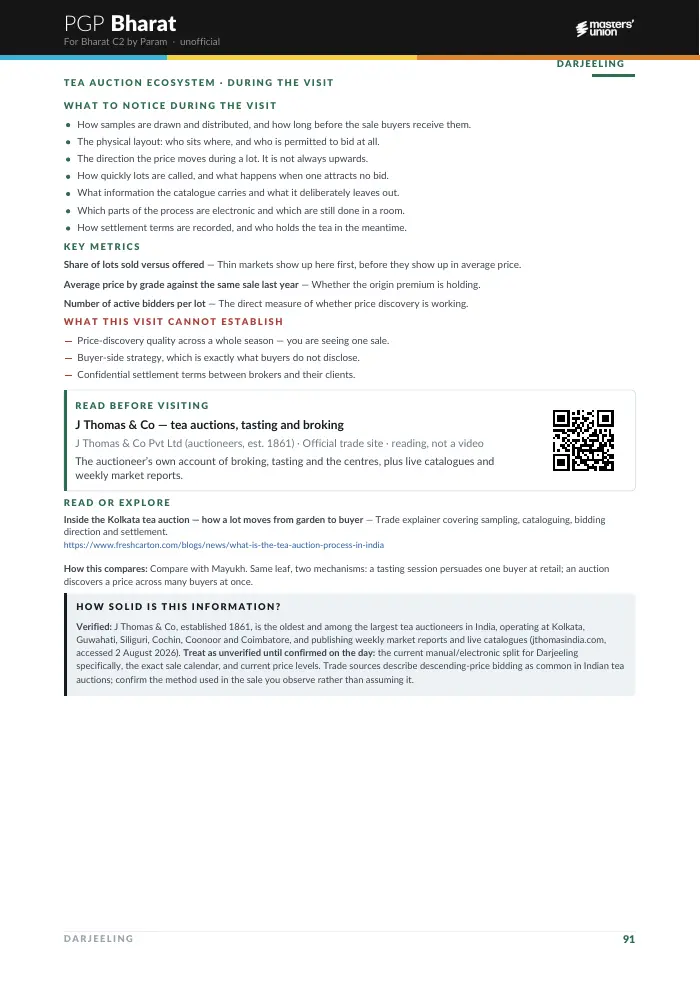
- How samples are drawn and coded
- Who can see which information
- What happens when bidding is thin
Numbers that reveal the system
- Bidders per lot
- Share sold below or above reserve
- Settlement time
Critical handoffs
- Factory to broker
- Broker sample to buyer
- Auction result to settlement
- Warehouse to winning buyer
THE C1 REALITY LAYER
Advice at the moment you need it.
Past-cohort precedent is separated from current C2 instructions. Anything changeable remains marked C2 VERIFY.Prepare the conditions
Auction dress and roles can change late
C1 Gymkhana guidance included a collared shirt or polo, no shorts or slippers, and footwear clarification shortly before departure. Students also received formal auction groups, assigned roles and simulation rules.
- Confirm the latest footwear rule.
- Learn your assigned role.
- Know reserve price and bid increment.
- Review lot quality, settlement, unsold lots and information asymmetry.
Trace the operating system
Treat the auction as a sequence, not theatre
C1 moved through market context, tea appreciation, a mock demonstration and auction participation. Watch how partial information becomes a bid and how settlement disciplines the winning moment.
C1 Tea Auction instructions · 10 March 2026C1 PHOTO DISPATCH
Real archive · contextual, not illustrative stock
DEEPER EXPLANATION
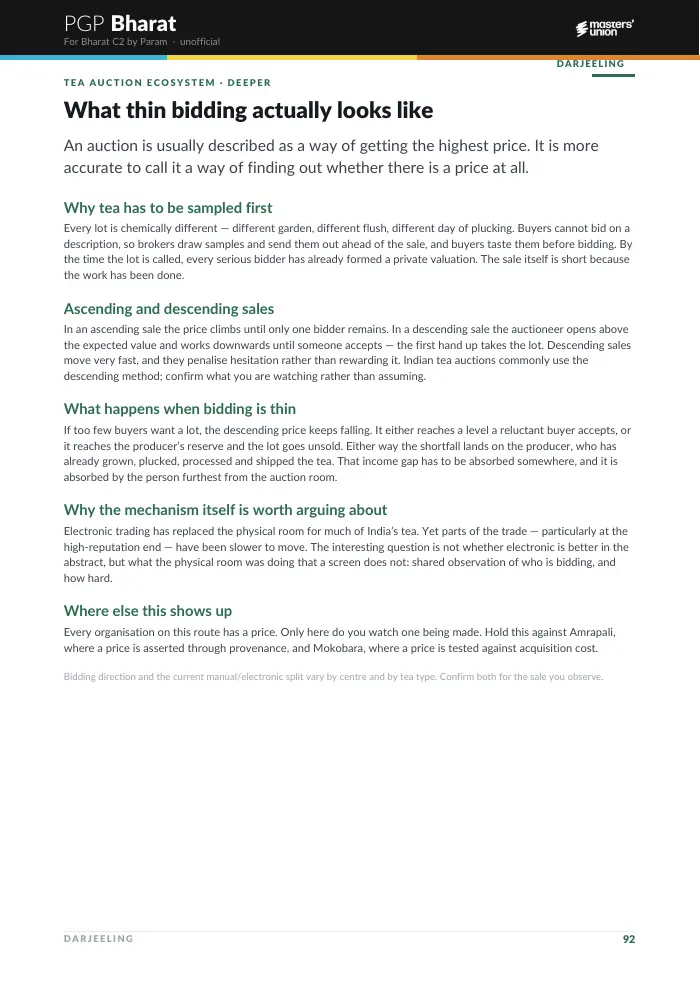
A discovered price needs a credible process
An auction does not reveal an intrinsic value. It creates a price from shared lot information, competing judgements and rules at one moment.
More bidders usually improve confidence, but only when they are independent and informed. A thin market can clear and still be weak evidence of value.
Compare Mayukh: one expert teaches one buyer to value difference; the auction coordinates many experts to reveal a clearing price.
Process explanation; not a claim about a particular auction session.USEFUL WORDS
Speak the language without hiding behind it.
- Reserve
- Minimum price a seller will accept.
- Bidder depth
- Number and seriousness of competing buyers.
- Price discovery
- Process by which market interaction produces a price.
- Settlement
- Transfer of money and title after the auction.
Evidence boundary
Watching a sale cannot establish cup quality, producer cost or whether the clearing price is sustainable.
Compare with Kalaari: both price uncertain assets, but on radically different time horizons.
WATCH / READ / EXPLORE
THE EXACT DESIGNED PAGES