The public, through taxation; Parliament also authorises public spending.
Live route status · Lucknow · current hubYou’re reading · Parliament of India

ORGANISATION FIELD BRIEF
FIELD EDITIONParliament of India
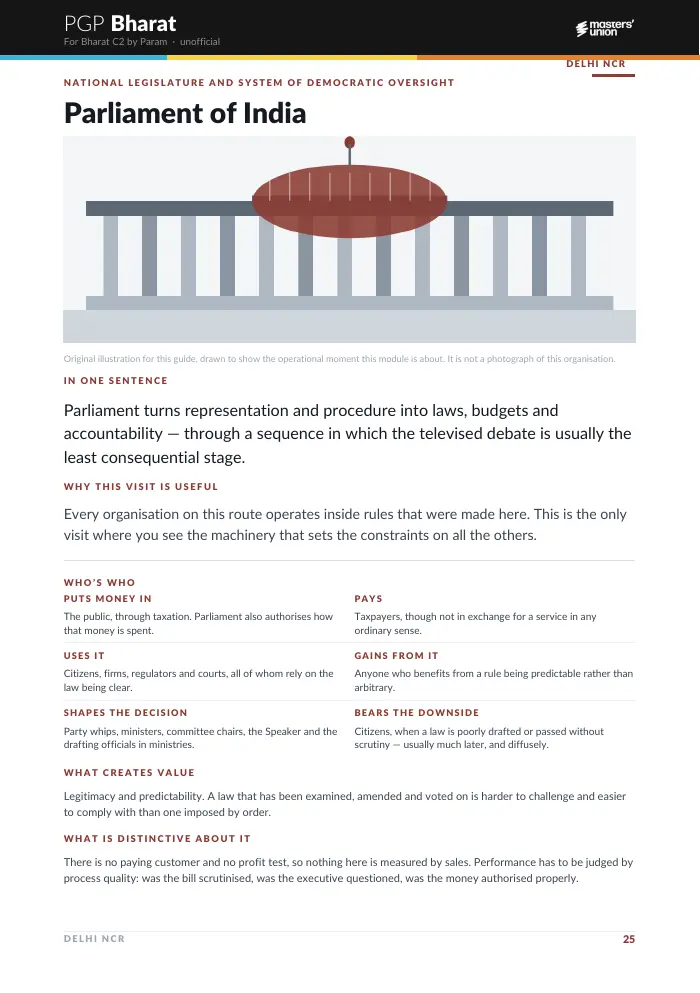
National legislature and system of democratic oversight
Parliament turns representation and procedure into laws, budgets and accountability through a sequence in which televised debate is usually the least consequential stage.
WHY THIS VISIT IS USEFUL
It exposes how legitimacy, scrutiny and implementation depend on procedure rather than speed.
WHAT IT CANNOT ESTABLISH
A tour cannot establish legislative quality, committee scrutiny or whether an Act is implemented after passage.THE SYSTEM MODEL
Who acts, who pays and who carries the downside?
Citizens, firms, regulators and courts that rely on predictable law.
Party whips, ministers, committee chairs, the Speaker and ministry drafting officials.
Citizens bear the diffuse, delayed cost of a poorly drafted or weakly scrutinised law.
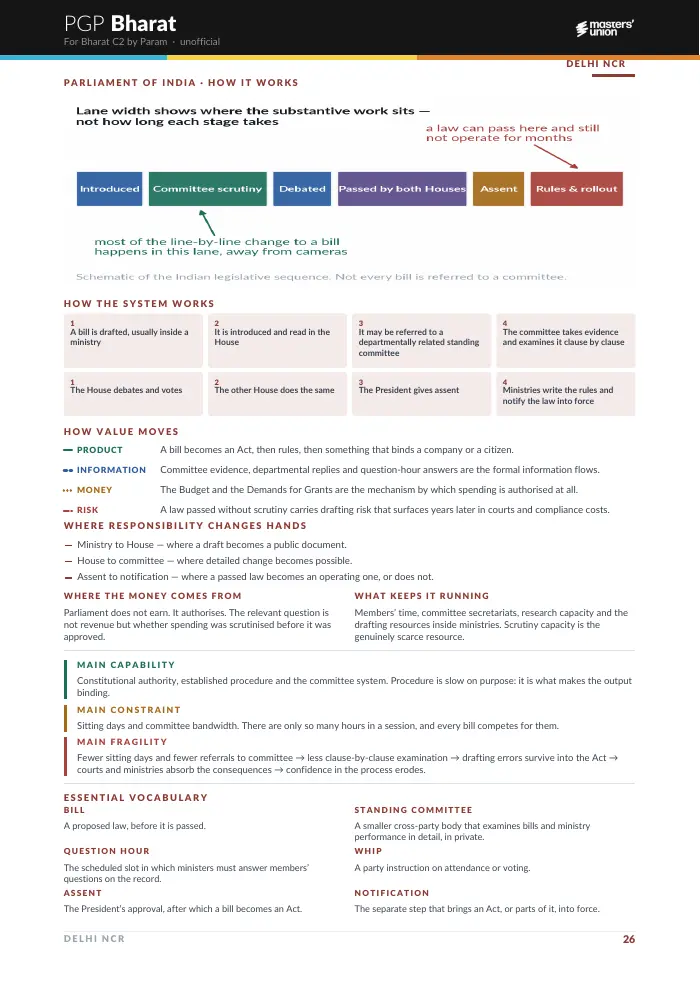
A proposal becomes a bill, then an Act, then rules and operating decisions.
Questions, committee evidence, amendments and public records move scrutiny through the system.
Parliament authorises taxation and expenditure; it does not earn revenue from a customer.
Rushed scrutiny can create ambiguous law whose costs appear later in administration, compliance and litigation.
Legitimacy, representation, scrutiny and a durable public record.
Time and attention for scrutiny, especially committee work and clause-by-clause examination.
Visible passage is treated as completion → subordinate rules lag → departments cannot implement → citizens see an announcement without an operating outcome.
ON THE GROUND
Look for evidence—not presentation polish.
What to notice
- How architecture shapes attention and hierarchy
- The difference between debate and clause-by-clause scrutiny
- Which stages occur outside the public chamber
Numbers that reveal the system
- Sitting days
- Bills referred to committees
- Time between assent and notification
Critical handoffs
- Ministry to legislature
- House to committee and back
- Assent to rule-making
- Rule to implementing department
THE C1 REALITY LAYER
Advice at the moment you need it.
Past-cohort precedent is separated from current C2 instructions. Anything changeable remains marked C2 VERIFY.Prepare the conditions
Parliament security precedent—confirm every item
C1 instructions included formals, comfortable closed footwear, extensive walking, physical Aadhaar plus programme ID, no valuables, and restrictions on phones, power banks, perfume, smartwatches, metal jewellery, rings, smart keys and other electronics.
- Read the latest official C2 list.
- Carry only the required original ID.
- Assume photography is prohibited until explicitly allowed.
- Wear shoes you can walk in for hours.
Trace the operating system
Security waiting is part of the system
Permissions can still be resolved at the gate. Notice how visible ceremony sits on top of quieter committee, scrutiny and implementation work.
C1 Parliament visit logTurn experience into evidence
Ask which inconvenience prevents an expensive failure
Parliament is a useful reminder that a control can look slow or inconvenient precisely because the consequence of failure is unusually high.
C1 archive synthesis · Parliament reflectionDEEPER EXPLANATION
A law is a chain, not an event
Televised debate is the visible moment. Drafting, committee scrutiny, rule-making and implementation determine whether the law is coherent and usable.
Counting bills passed measures activity. A stronger completion measure asks whether rules were notified, institutions were prepared and intended outcomes followed.
That distinction returns at Invest UP: a signed intention and an operating factory are also separated by a long implementation chain.
USEFUL WORDS
Speak the language without hiding behind it.
- Bill
- A legislative proposal before it becomes law.
- Act
- A bill after passage and assent.
- Standing committee
- A smaller cross-party body that can examine detail and evidence.
- Subordinate legislation
- Rules and notifications made under authority granted by an Act.
Evidence boundary
Use official bill texts, committee reports and notifications for factual claims. A tour reveals architecture and procedure, not legislative quality.
Compare with Invest UP: both convert a formal decision into an operating outcome through many hands.
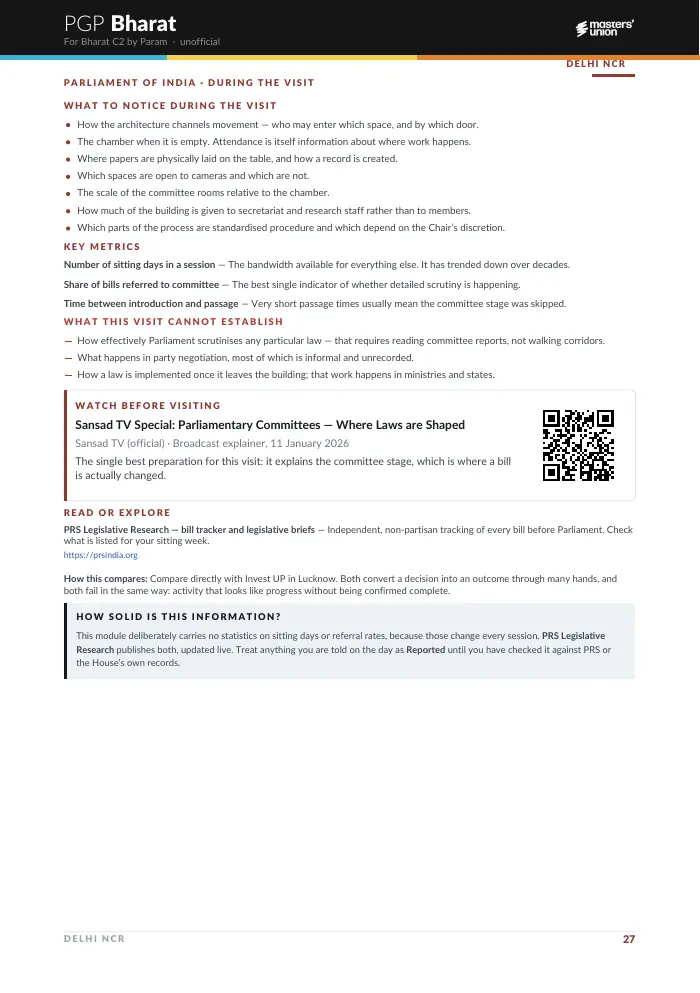
WATCH / READ / EXPLORE
THE EXACT DESIGNED PAGES