International buyers, retailers, interior specifiers and households.
Live route status · Lucknow · current hubYou’re reading · Jaipur Rugs
ORGANISATION FIELD BRIEF
FIELD EDITIONJaipur Rugs
Hand-knotted carpets, distributed artisan production, global export
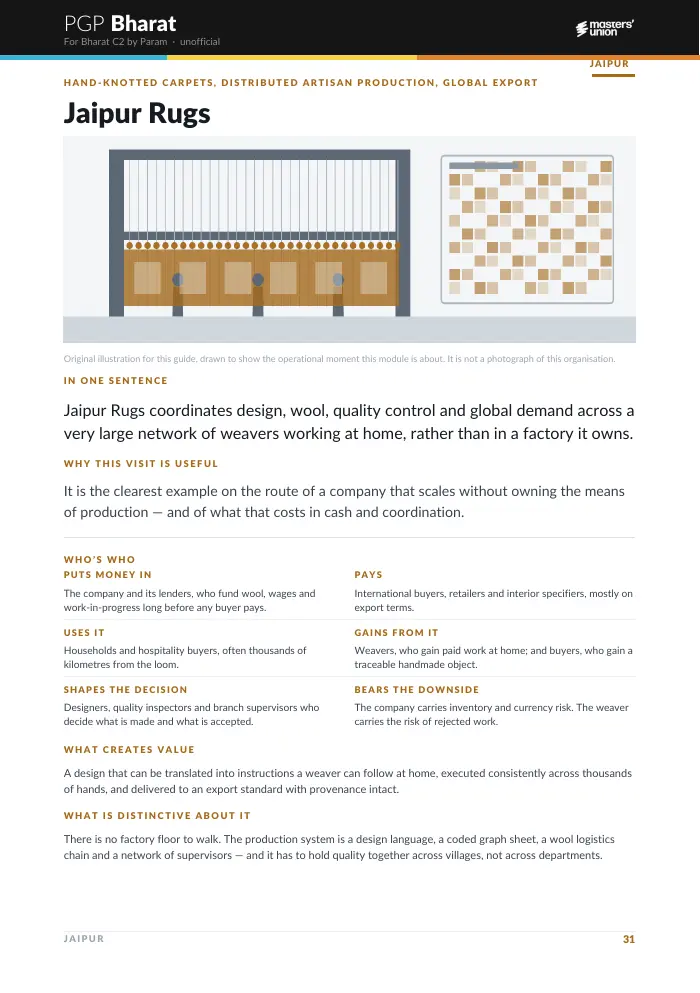
Jaipur Rugs coordinates design, wool, quality control and global demand across a very large network of weavers working at home rather than in a factory it owns.
WHY THIS VISIT IS USEFUL
It reveals what must replace supervision when production is geographically distributed.
WHAT IT CANNOT ESTABLISH
A showroom or office visit cannot establish household-level working conditions or the true rejection burden.THE SYSTEM MODEL
Who acts, who pays and who carries the downside?
Households and hospitality buyers; weavers and buyers gain from a credible chain.
Designers, quality inspectors and branch supervisors.
The company carries inventory and currency risk; a weaver may carry the cost of rejection.
Wool → home loom → finishing → container → buyer.
Graph sheets and instructions move down; inspection notes and progress move up.
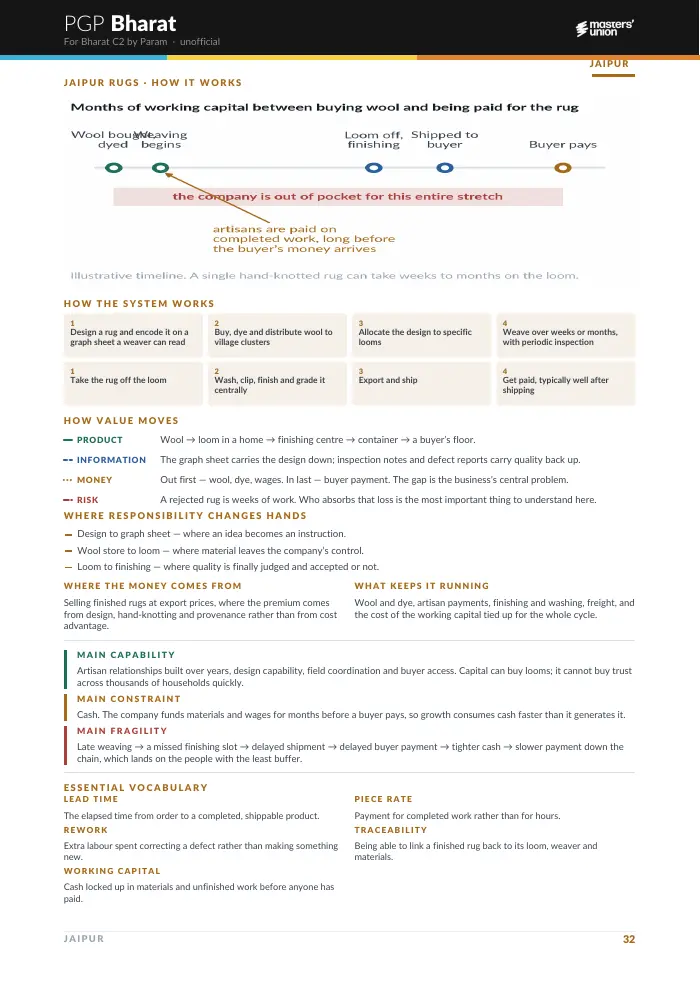
Wool, weaving and finishing are paid before export revenue arrives.
A rejected rug can embody weeks of work; the contract decides who absorbs it.
Artisan relationships, design translation, distributed coordination and global buyer access.
Cash. Production takes months while payment often follows shipment.
Late weaving → missed finishing slot → late shipment → late payment → tighter cash → slower payments across the chain.
ON THE GROUND
Look for evidence—not presentation polish.
What to notice
- Where unfinished work is inspected
- How a design becomes instructions a home-based weaver can follow
- Who absorbs the cost of a rejected or delayed piece
Numbers that reveal the system
- Rejection and rework rate
- Lead time
- Traceability to loom and weaver
Critical handoffs
- Designer to graph sheet
- Branch supervisor to home loom
- Weaver to inspector
- Finished rug to exporter and buyer
THE C1 REALITY LAYER
Advice at the moment you need it.
Past-cohort precedent is separated from current C2 instructions. Anything changeable remains marked C2 VERIFY.Connect it across the route
Compare Jaipur Rugs with Ada and SEWA
Both coordinate home-based work beyond a conventional factory. Compare who turns designs into distributed instructions, who sets quality, who can reject work and who absorbs the lost time of rework.
C1 Ada/SEWA archive · adjacent caseDEEPER EXPLANATION
Distributed production moves costs; it does not remove them
Home-based weaving lowers factory capital, but replaces direct supervision with instruction, travel, inspection, relationship management and late defect discovery.
Growth can worsen cash: more orders require more wool and more work in progress long before the buyer pays.
The model trades capital intensity for coordination intensity. The real system is the graph sheet, the branch network and the inspection rhythm—not simply the loom.
USEFUL WORDS
Speak the language without hiding behind it.
- Lead time
- Elapsed time from commitment to finished delivery.
- Piece rate
- Payment per completed unit rather than time.
- Rework
- Correcting output that fails inspection.
- Traceability
- Ability to follow a piece back through its production history.
Evidence boundary
Network scale and commercial figures are company-reported. A showroom or office visit cannot establish household conditions or the true rejection burden.
Compare with Ada Chikan: the same distributed structure under different governance.
WATCH / READ / EXPLORE
THE EXACT DESIGNED PAGES