Platforms, advertisers and sometimes audiences pay; investors fund the slate.
Live route status · Lucknow · current hubYou’re reading · The Viral Fever (TVF)
ORGANISATION FIELD BRIEF
FIELD EDITIONThe Viral Fever (TVF)
Digital content production and intellectual property
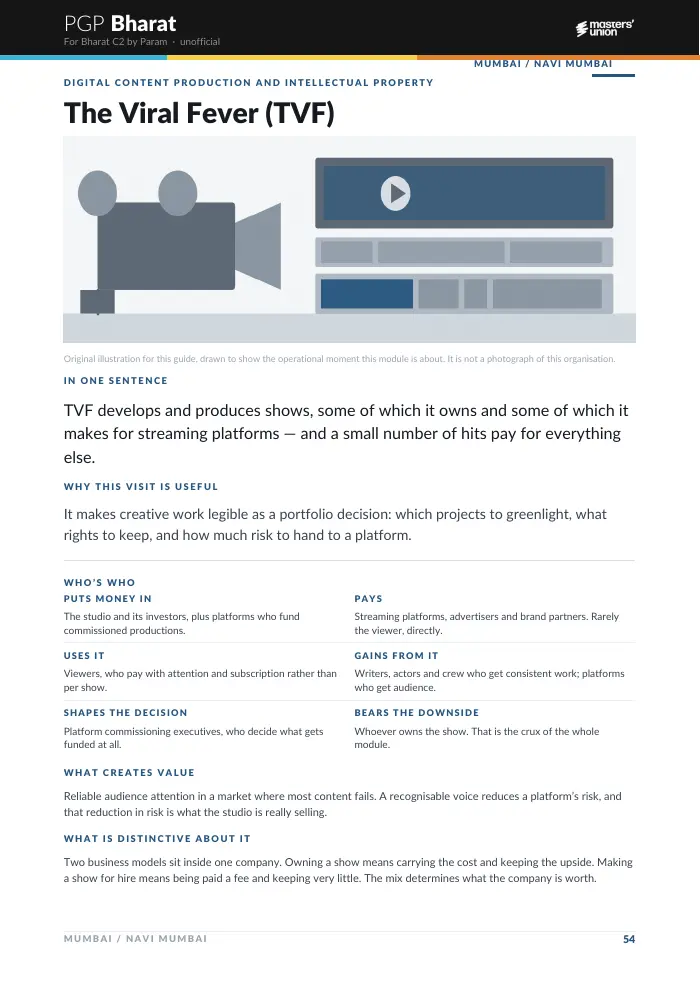
TVF develops and produces shows, some of which it owns and some of which a streaming platform pays for, while a small number of hits carry the slate.
WHY THIS VISIT IS USEFUL
It shows power-law outcomes, greenlight judgement and why ownership matters more than view counts alone.
WHAT IT CANNOT ESTABLISH
A studio visit cannot reveal platform terms, complete project P&Ls or the counterfactual value of rejected ideas.THE SYSTEM MODEL
Who acts, who pays and who carries the downside?
Viewers and commissioning platforms.
Writers, producers, platform commissioning teams and performance data.
The studio bears development write-offs; ownership terms decide who retains upside.
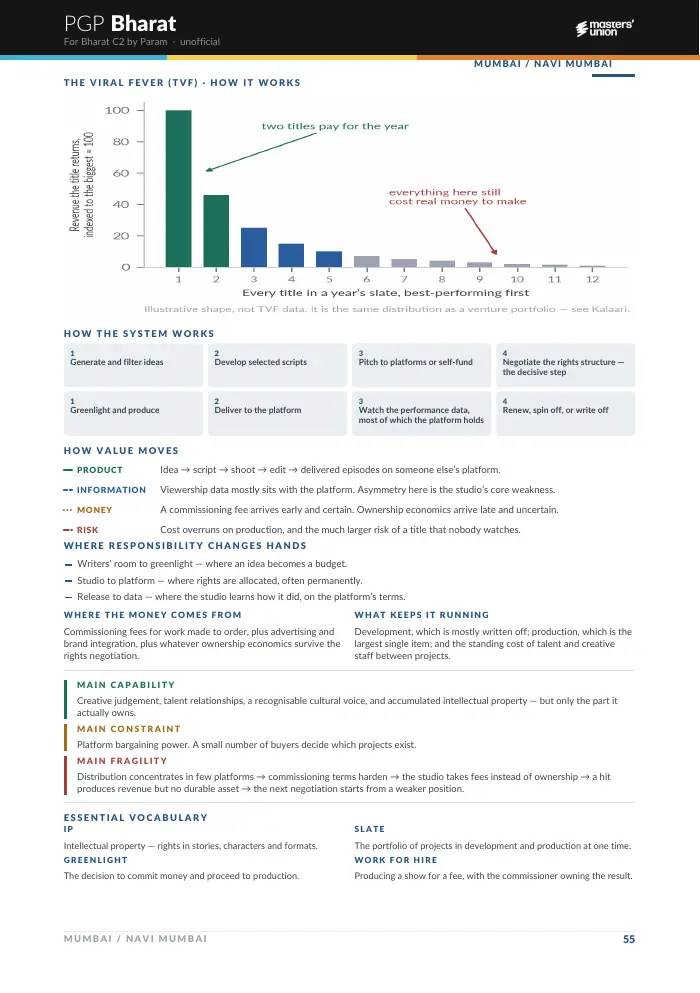
Idea → script → production → finished episodes → platform audience.
Creative notes move down; incomplete platform performance data moves back.
Development and production precede uncertain commissioning fees, advertising or rights value.
Every project costs; a few titles produce most of the value, and rights may sit elsewhere.
Creative judgement, talent relationships, a recognisable cultural voice and owned IP.
Platform bargaining power: a small number of buyers decide which projects exist and on what terms.
Distribution concentrates → terms harden → the studio accepts fees instead of ownership → a hit creates revenue but no durable asset → the next negotiation starts weaker.
ON THE GROUND
Look for evidence—not presentation polish.
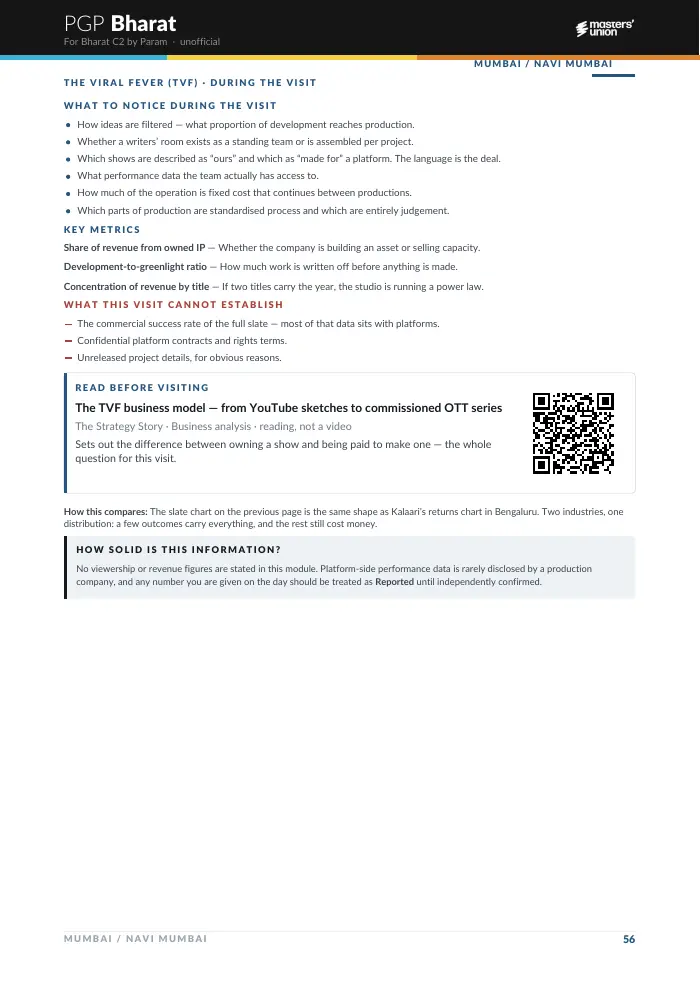
What to notice
- How ideas are filtered before production
- Where ownership changes in commissioned work
- How audience evidence enters a creative decision
Numbers that reveal the system
- Development-to-greenlight rate
- Owned-IP share
- Hit contribution to slate economics
Critical handoffs
- Development to greenlight
- Studio to platform
- Production to post-production
- Release to long-term rights ownership
THE C1 REALITY LAYER
Advice at the moment you need it.
Past-cohort precedent is separated from current C2 instructions. Anything changeable remains marked C2 VERIFY.Prepare the conditions
Reverse-engineer the format before praising the idea
C1 creator tasks treated public audience feedback as part of learning. Students were pushed to study formats that already worked and combine voiceover, movement, footage and editing where the story needed it.
C1 Creator Challenge archiveTrace the operating system
Interrogate the greenlight
Ask who the actual audience is, which metric changes a commissioning decision, how a concept is tested cheaply, where a promising project dies and who owns the audience data.
Field Companion and C1 creator-metric debateTurn experience into evidence
Views are not a neutral scoreboard
C1 debated how raw views favour people with larger starting audiences. Engagement can be more informative but remains imperfect; editorial judgment and public response can legitimately disagree.
C1 Creator Challenge archiveUSEFUL WORDS
Speak the language without hiding behind it.
- IP
- Rights in stories, characters and formats.
- Slate
- The portfolio in development and production.
- Greenlight
- Decision to commit money and proceed.
- Work for hire
- Production for a fee with the commissioner owning the result.
Evidence boundary
No viewership or revenue figures should be inferred from a visit. Platform data and rights contracts are confidential.
Compare with Kalaari: a few outcomes carry the whole portfolio.
WATCH / READ / EXPLORE
THE EXACT DESIGNED PAGES