Enterprises, cloud providers and other tenants pay for capacity and uptime.
Live route status · Lucknow · current hubYou’re reading · Yotta Infrastructure
ORGANISATION FIELD BRIEF
FIELD EDITIONYotta Infrastructure
Hyperscale data-centre capacity and colocation
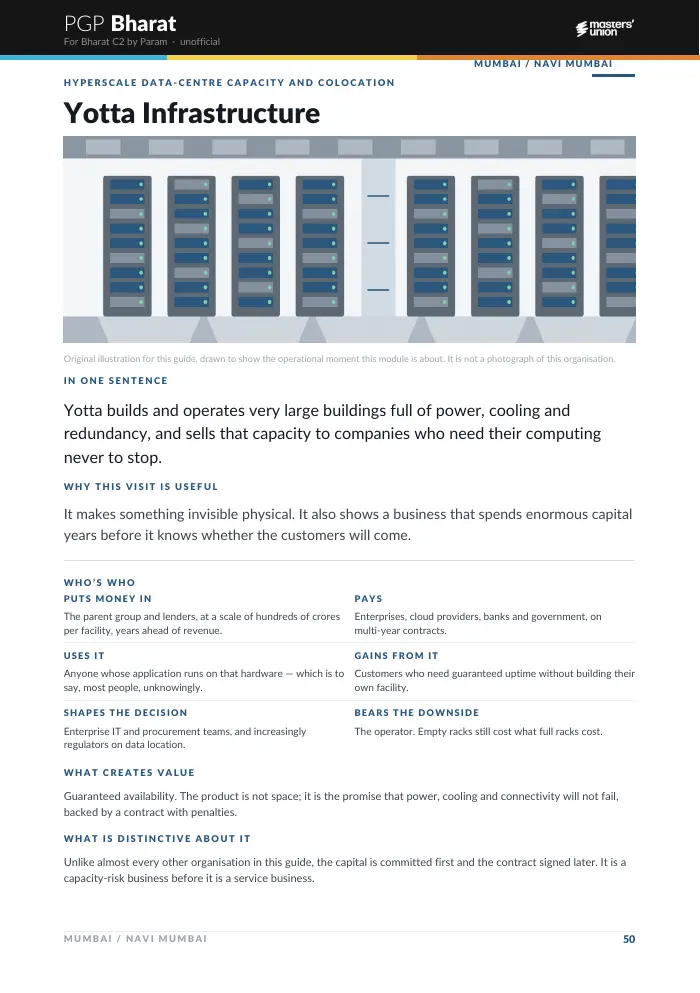
Yotta builds and operates very large buildings full of power, cooling and redundancy, then sells that capacity to companies whose computing must never stop.
WHY THIS VISIT IS USEFUL
It is a capital-first business where reliability is the product and low utilisation can destroy returns.
WHAT IT CANNOT ESTABLISH
A guided visit cannot establish actual uptime, utilisation, customer concentration or return on capital.THE SYSTEM MODEL
Who acts, who pays and who carries the downside?
Organisations and users whose computing must continue.
Customer infrastructure teams, reliability commitments and regulators.
The operator bears capital and outage risk; customers bear business interruption.
Grid power and connectivity become cooled, secure computing capacity.
Sensors, alarms and incident procedures flow to a control room and customer reports.
Capital is spent years before recurring colocation revenue fills capacity.
A single weak handoff can interrupt workloads despite layers of redundancy.
Reliable power, cooling, redundancy, security, connectivity and operating discipline in one site.
Utilisation. Empty commissioned capacity still consumes capital and base operating cost.
Load grows faster than power or cooling headroom → redundancy is consumed → a routine failure becomes an outage → trust and contracts are damaged.
ON THE GROUND
Look for evidence—not presentation polish.
What to notice
- Hot-aisle and cold-aisle discipline
- Redundancy at each handoff
- What is measured at facility versus rack level
Numbers that reveal the system
- Rack utilisation
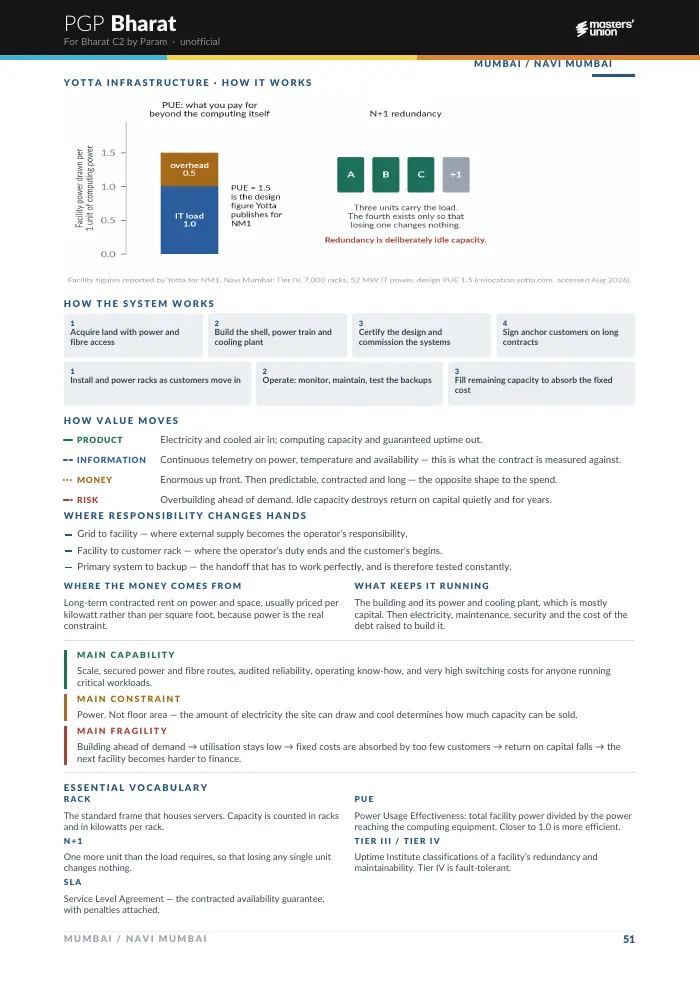
- Power Usage Effectiveness
- SLA uptime and incidents
Critical handoffs
- Grid to backup power
- Electrical system to rack
- Cooling plant to IT load
- Facility team to customer equipment
THE C1 REALITY LAYER
Advice at the moment you need it.
Past-cohort precedent is separated from current C2 instructions. Anything changeable remains marked C2 VERIFY.Connect it across the route
A capable facility can still fail at the gate
C1 port and industrial visits showed that physical access permissions can become the operating bottleneck. Redundancy matters only if people, passes and transport hand off into it successfully.
C1 ports and industrial archive · adjacent caseDEEPER EXPLANATION
Reliability is a chain
A data centre does not sell a building. It sells continuity across grid, generators, switching, cooling, network, security and human response.
Redundancy only helps when failures are independent and changeovers work. A shared dependency can make two nominally separate systems fail together.
Utilisation determines whether the capital earns. Reliability determines whether the revenue survives.
Structural explanation; not facility performance data.USEFUL WORDS
Speak the language without hiding behind it.
- PUE
- Total facility power divided by power used by computing equipment.
- Redundancy
- Extra capacity that takes over after failure.
- SLA
- A contractual service-level commitment.
- Rack utilisation
- Share of saleable rack or power capacity occupied.
Evidence boundary
A tour cannot establish actual uptime, utilisation, customer concentration or return on capital. Use operating records and contracts for those claims.
Compare with Cordelia and Glenburn: capacity expires even when nothing visibly breaks.
WATCH / READ / EXPLORE
THE EXACT DESIGNED PAGES